Forum Moderators: open

Message Too Old, No Replies

Interesting Hard Drive Failure Statistics By Cloud Storage Business


engine

4:30 pm on Aug 3, 2016 (gmt 0)

WebmasterWorld Administrator 10+ Year Member Top Contributors Of The Month


One of the major users of hard drives is the cloud storage sector, and one of them publishes stats on hard drives and its failures.

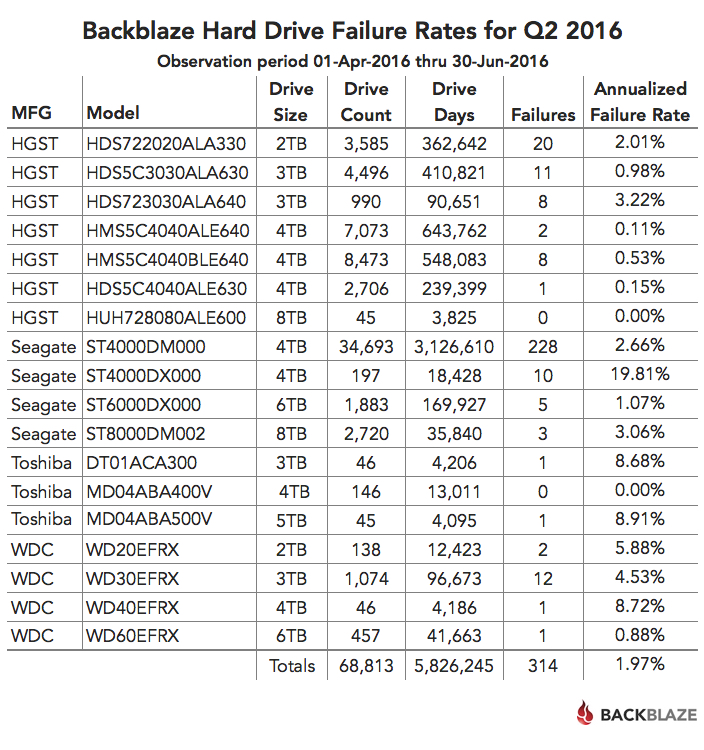
It's always worth a read as it indicated a trend, or types of drives to avoid. The full story is here, but here's a chart showing some figures for the quarter, April to June, 2016 [backblaze.com...]

https://www.backblaze.com/blog/wp-content/uploads/2016/07/blog-q2-failure-rates.jpg

lammert

5:02 pm on Aug 3, 2016 (gmt 0)

WebmasterWorld Senior Member 10+ Year Member Top Contributors Of The Month


Besides the differences between the models, also the average rate is interesting. 1.97% for Q2 2016, which gives an average 8% drive failure rate per year. Good reason to have proper backups in place.

What is missing in these statistics is the age of the drives at failure. All failing drives I had were failing in the first week. Those that didn't fail in the first week all ran for years.

IanCP

8:07 pm on Aug 3, 2016 (gmt 0)

WebmasterWorld Senior Member 10+ Year Member Top Contributors Of The Month


Heh! Heh!
Good reason to have proper backups in place

Backups for the Cloud, which is a backup. Yes, backups of backups. Lessons I've learned the hard way over the years.

In a domestic environment, cost becomes your limiting factor, depending upon your individual financial circumstances.
All failing drives I had were failing in the first week. Those that didn't fail in the first week all ran for years

In the world of electronics, that has always been a truism. Going back 40 years ago, Military Specification integrated circuits were "burnt in" for a specified period. From memory, something like 1,000 hours.

In other words, depending upon the IC, it was put through its paces doing reiterations for 1,000 hours. Failure rate those days was around 3% from memory. It would be much less today with modern fabrication technology.

An interesting topic for Geeks - dead boring for the average person in the street.

The olden day joke went something like: "Did you know your 747 Jumbo Jet is controlled by recycled, used components? Even critical medical instrumentation which keeps you alive in hospital".

In theory, barring other external catastrophic events, integrated circuits should be good for a nominal 1,000 years after burn in.

I had a friend who worked with a molecular microscope [Electron Microscope]. One day in the Electronics Group we all belonged to, we were arguing over the necessity to ground yourself when handling modern CMOS integrated circuits. One school of thought argued it was essential, another argued it was pointless and not necessary because they never saw any ill effect on the circuit.

Our friend posted two molecular photographs to the Group. One was of a perfect undamaged transistor embedded within the IC. The other was an identical transistor, but from an IC where the pins had been touched by human hands and the static electricity within our bodies. Both IC's had performed perfectly - the latter had chunks chewed away from the molecules. As our friend asked:

Would you place your life in the hands of that transistor when next flying in a 747 at 6,000 metres up in the sky?

That killed off that discussion.

Sorry for diverging, but remember that story the next time you pick up a new motherboard in your hands. Static electricity in your body? I can give you a simple, inexpensive test to prove it. Not a bad party tricks as well. You need to be able to buy a cheap NE-2 Neon Bulb though.

tangor

9:28 pm on Aug 3, 2016 (gmt 0)

WebmasterWorld Senior Member 10+ Year Member Top Contributors Of The Month


I imagine drives in the cloud get a more constant workout than home or office systems. A popular web server might elevate read/writes significantly.

As for lasting ... I have a 20mb (that's megabyte) HD in a legacy 286 used for very special work that has been running flawlessly since 1985

robzilla

10:36 pm on Aug 3, 2016 (gmt 0)

WebmasterWorld Senior Member 10+ Year Member Top Contributors Of The Month


I have a 20mb (that's megabyte) HD in a legacy 286 used for very special work that has been running flawlessly since 1985

Hey, that's how long I've been running, too! I guess that means my body is no more (or less) reliable than a 20 megabyte hard drive.

Would be interesting to see such statistics for SSDs, but judging from the comments they don't make economical sense for them yet.

tangor

2:40 am on Aug 4, 2016 (gmt 0)

WebmasterWorld Senior Member 10+ Year Member Top Contributors Of The Month


SSD has its place .. but long term mass storage still looks to spinning rust for a place to live.

creeking

12:13 pm on Aug 4, 2016 (gmt 0)

10+ Year Member


also the average rate is interesting. 1.97% for Q2 2016, which gives an average 8% drive failure rate per year.


the 1.97 percent is annualized. not per quarter.

so, call it 2% per year.

lammert

12:43 pm on Aug 4, 2016 (gmt 0)

WebmasterWorld Senior Member 10+ Year Member Top Contributors Of The Month


Thanks for the correction :) 2% also better matches my own experience.

engine

1:49 pm on Aug 4, 2016 (gmt 0)

WebmasterWorld Administrator 10+ Year Member Top Contributors Of The Month


Talking of SSDs, there's a paper and presentation audio and it's worth listening to the presentation and running through the slides.
As this is an in-use study over 6-years it is gives a much better idea of reliability.
Authors:
Bianca Schroeder, University of Toronto; Raghav Lagisetty and Arif Merchant, Google, Inc.
Comparing with traditional hard disk drives, flash drives have a significantly lower replacement rate in the field, however, they have a higher rate of uncorrectable errors. Flash Reliability in Production: The Expected and the Unexpected [usenix.org]

J_RaD

3:54 am on Aug 25, 2016 (gmt 0)


What is missing in these statistics is the age of the drives at failure. All failing drives I had were failing in the first week. Those that didn't fail in the first week all ran for years.


I've got you beat! All my drives fail within HOURS LOL if they can get passed a full windows install, drivers, updates, and they don't tank.. im normally good :-)

I wish this chart listed drives most people normally buy... 500gb .. 1TB .. etc

Seagate is still in my "beware" category
WD is in my "mostly good" category along with HGST

10+ years ago seagate was top dog, and WD was the crash master.

J_RaD

4:00 am on Aug 25, 2016 (gmt 0)


Comparing with traditional hard disk drives, flash drives have a significantly lower replacement rate in the field, however, they have a higher rate of uncorrectable errors


that should be glaring obvious given how they operate. HDDs have much more wiggle room in recovering data all the way down to platter removal.
Once a memory chip is worn, thats it, its gone, nothing to see. Buy SSDs with good controllers....or suffer.