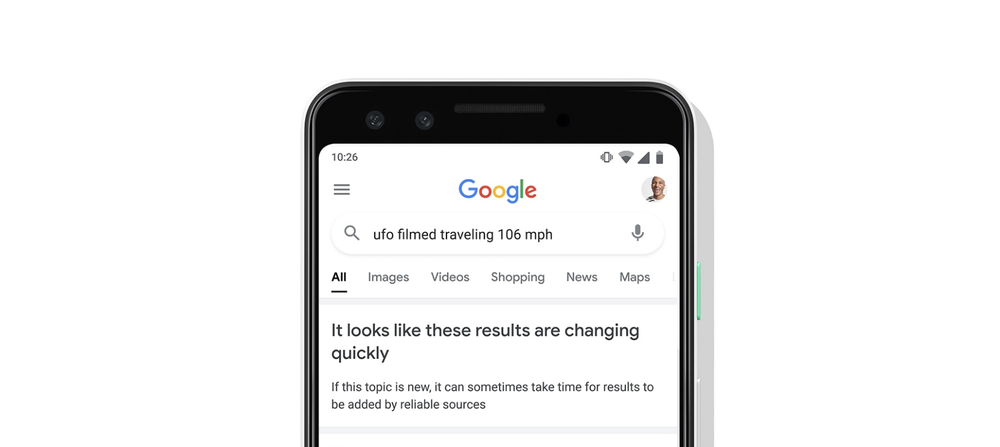
Edit: P.S. I should add that a search engine like google might be slower than a live news channel because of the delay between when a web page is published or updated and when googlebot crawls it and the algorithm digests it.
aristotle... yes and no. That was my first thought too... "Why not check Twitter or turn on the radio?" is what came to my mind... but I think that Google has framed this very well. An excerpt from their blog post, with my emphasis added...
This can be particularly true for breaking news or emerging topics, when the information that's published first may not be the most reliable.
To help with this, we’ve trained our systems to detect when a topic is rapidly evolving and a range of sources hasn’t yet weighed in.
Slightly off topic... I'm suspecting this may have implications for the general Google search algorithm as well. To me, this suggests that diversity of key sources is a factor in establishing veracity and perhaps detecting Fake News... but that the "range" of diversity may well be niche specific. Additionally, it might be type-of-story specific. As Google states, it has been
"training {its} systems".
I'm thinking also that different types of stories might require different approaches....
Something like a plane crash has an urgency to publish that might also cause Google to slow down enough to double-check the facts before publishing news stories about it. Eg, was it an accident or caused by hostile action? Is it likely or not that there will be survivors?
The collapse of the building in Florida is another fascinating example... the first chapter basically the shocking nature of the disaster, and the search and rescue phase, both coupled with sensitivities about possible survivors. Then, there will be exploration of the causes, connection with rising salt water levels and storm surges, subsequent insurance issues for coastal property, etc.
I suspect that a slowly evolving story like Covid-19 might be the most difficult kind of story to deal with, because the range of sources is still evolving. Initially, they were limited by the "novel" nature of the virus, but made urgent by the medical situation. Beyond that, there's the evolving nature of both the virus and our understanding of it, of contagion, mutations, vaccinations, and the whole question of readiness for future pandemics. Political and economic implications also enter into it.
I'm sure Google will further nuance the algorithm for different phases of different kinds of stories.