Forum Moderators: Robert Charlton & goodroi

Message Too Old, No Replies

Google Passage Ranking Live in U.S., English Language


engine

11:29 am on Feb 15, 2021 (gmt 0)

WebmasterWorld Administrator 10+ Year Member Top Contributors Of The Month


Google has said passage ranking is now live in the U.S. for English language queries, with other countries and languages to roll out later. The passage ranking will affect 7% of queries across all languages when it's filly rolled out.
With new passage understanding capabilities, Google can understand that the specific passage (R) is a lot more relevant to a specific query than a broader page on that topic (L).
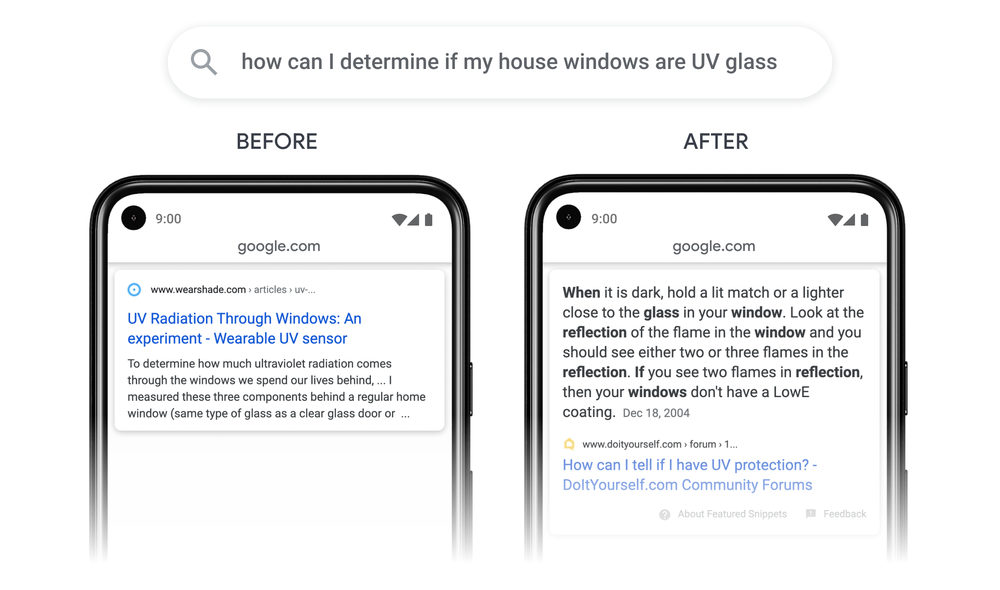
[twitter.com...]
https://storage.googleapis.com/gweb-uniblog-publish-prod/images/UnderstandingPassages.max-1000x1000.png

Want to know more about passage ranking, here's what Google said [blog.google...]

JesterMagic

1:35 pm on Feb 15, 2021 (gmt 0)

WebmasterWorld Senior Member 10+ Year Member Top Contributors Of The Month


I was hoping this would be used to show more relevant pages, that it.

I see now Google shows the passage as almost a featured snippet which means the user doesn't have to visit my website and gets to stay on Google.

Enough is enough. Government needs to step up and prevent Google from doing this and slowly bankrupting businesses.

Sure Google is planning to pay large media organizations but I am sure it is not enough, and how about the rest of us small businesses? Don't we count?

This is one of the more scary things Google has done of late.

saladtosser

2:55 pm on Feb 15, 2021 (gmt 0)

5+ Year Member Top Contributors Of The Month


Wow, that's shocking. I don't understand googles long term logic in hurting the content creators it uses to wrap its ads around... content creation will become 2 expensive to bother if this continues, then what will they show? I'm guessing AI written articles will be the end game based on 25 years of aggregated information, removing the need for a lot of publishers.

engine

3:45 pm on Feb 15, 2021 (gmt 0)

WebmasterWorld Administrator 10+ Year Member Top Contributors Of The Month


The concept is technically very clever, and I wonder if the extract is small enough to not fall foul of copyright law, in that it's a short passage.

If it locks people onto Google, without clicking through, then it serves Google's purpose. However, it doesn't look good if the originator gets nothing for their efforts; no clicks, no pageviews, nothing. I don't understand why it couldn't be better if it only showed a very short piece and simply said "click here for more..." Wait, I do know why they wouldn't.

iamlost

6:39 pm on Feb 15, 2021 (gmt 0)

WebmasterWorld Senior Member 10+ Year Member Top Contributors Of The Month


Basically Google has had sufficient featured snippets experience aka ML training time since 2014 (if memory serves) to now be able to confidently pull featured snippet aka fair use answers from others content without assistance.

I posted the following 3-years ago:

Snippets on search query results pages are merely the testbed...
...I'm sure G appreciates your freely proffered properly annotated fairly used content.

Let’s get serious with some numbers from an Ahref study:
* a first result with no snippet present: ~52% ctr.
* a first result following a snippet: ~20% ctr.
* a snippet with no following first result: 9% ctr.
Note: this implies that ~40% saw no need to click further.

Snippets are a net retention gain to Google and a net loss to a site’s organic search traffic.
Plus the visitor satisfaction is now with Google not the site that created the answer; a net reputation gain to Google and a net loss to the site.

If no snippet works with this new scrape and publish method well and good, if not mmmm...

aristotle

7:38 pm on Feb 15, 2021 (gmt 0)

WebmasterWorld Senior Member 10+ Year Member Top Contributors Of The Month


As a counter augument, this could move a smaller site to the top of the rankings if it has the sought-after information. Whereas previously this site would have been buried down on page 5 because it doesn't have any authority.

Another example would be a new site that would get exposure that it wouldn't have otherwise received.

Of course in many cases these sites should have already been ranked at the top, so from that viewpoint this just corrects a previous injustice that google had inflicted on them. But at least it corrects the injustice.

JesterMagic

8:32 pm on Feb 15, 2021 (gmt 0)

WebmasterWorld Senior Member 10+ Year Member Top Contributors Of The Month


Fair Use laws (which granted I don't know much about) need to be reworked when it comes to services like Search Engines.

For example. I created the Best Ever Q&A page that answered every question in a sentence or 2.

Now days in the world of Featured Snippets and Passage Snippets Google is free to quote any part of my site in multiple different ways and can show different quoted text depending on the search the user did. The user can search for 10 different things, and Google could just return a unique Passage Snippet from my Q&A page for each one keeping the visitor on Google. They can just keep reusing the page quoting any text on the page like they own it.

For website who use the FAQ schema on a page Google has been doing something similar to the above for a year or so now. In the SERPS under a result you will find an accordion widget that displays up to 10 of the questions and answers from the FAQ. I add Schema to my web pages so Google can better understand them so they can return the best page for the search term, not to allow Google to display all my content.

I have a feeling a part of the reason for Passage Snippets is to allow Google Assistant to use other content when a user asks a question.

JorgeV

8:45 pm on Feb 15, 2021 (gmt 0)

WebmasterWorld Senior Member 5+ Year Member Top Contributors Of The Month


Hello,

small enough to not fall foul of copyright law

The size of a quote, has nothing to do with copyright law. This is a wrong assumption that the "laws" are defining a "size". Even if a quote is small, but reprises most of the information of the main text, this falls into copyright law. I can't remember, but there are examples, of small quotes, which were condemned for copyright infringement .

note: "fair use" is not a law, it's a subjective concept, that a judge may take in consideration.

NickMNS

8:51 pm on Feb 15, 2021 (gmt 0)

WebmasterWorld Senior Member 10+ Year Member Top Contributors Of The Month


As a counter augument, this could move a smaller site to the top of the rankings if it has the sought-after information. Whereas previously this site would have been buried down on page 5 because it doesn't have any authority.

Another example would be a new site that would get exposure that it wouldn't have otherwise received.

I totally and completely disagree. Google must use the site ranking and authority as factor, there is no way for Google to "know" the correct answer for any query, instead they infer what is correct based on a factor, likely including click through rates to the query results (pre-featured snippets) and of course site authority and rank.

This is very dangerous, from an epistemological perspective, it means that it will reinforce and further confirm popular ideas of what is "correct" or "true" and will further marginalize less well know but factually correct truths. Using Popper's Black Swan example, the query "are all swan's white" would produce Yes as the answer, as most people in Europe would have only ever seen white swans, and seen them many times, and at any time now and in the future. But there will have been a few people that had traveled outside of Europe and then by chance come across the unlikely black swan. In this case the query is proven false with the observation of a single instance of a black swan. But, Google's algorithm would marginalize this single observation and continue to reinforce the now deeply held but factually incorrect belief that all swan are white. To change this perception would require you to bring the existence of a black swan to the attention of authoritative entities (websites) and have them confirm veracity of your claim. This verification is in and of itself is not an issue, the problem is that the means of achieving this, by publishing your findings and having those publications discovered becomes impossible as the Google algorithm pushes them further out of the search results.

Given the current social/political situation that we face, not just in the US, or even in Europe but really globally, where is this going to leads us.

Add to the that Google's monopolistic position, it has essentially declared itself the standard bearer of the truth.

lucy24

9:24 pm on Feb 15, 2021 (gmt 0)

WebmasterWorld Senior Member 10+ Year Member Top Contributors Of The Month


Huh. I've noticed recently an uptick in google referers being sent directly to a fragment. Not visible in logs, of course (request or referer), but analytics shows the fragment.

But since they persist in not letting us see the search query that leads to the fragment, it's impossible to know if this targeted action was appropriate or misguided.

Trivia: At time of posting, for my specific circumstances, the query “are all swans white” leads to the wikipedia article “Falsifiability”.

JorgeV

10:19 pm on Feb 15, 2021 (gmt 0)

WebmasterWorld Senior Member 5+ Year Member Top Contributors Of The Month


Addendum, to my previous post. Google is certainly counting on the factual nature of the information contained in such paragraphs. This is certainly why it should concern only 7% of queries. You cannot claim the copyright of a "fact" , but you can claim the copyright of the text exposing the fact. Google is certainly exploiting this blur line.

aristotle

11:23 pm on Feb 15, 2021 (gmt 0)

WebmasterWorld Senior Member 10+ Year Member Top Contributors Of The Month


NickMNS wrote:
there is no way for Google to "know" the correct answer for any query

That's corrrect, but it doesn't invalidate what I said.

As an example, if someone wants to know how tall the ancient Greek poet Homer was, and there is only one site on the web that mentions (or speculates about) his height, then google should move that site to the top of the rankings, even if nobody really knows for sure how tall he was. Then the visitor to the site can at least see what someone else thinks or specualtes about the matter. That's usually better than no information at all.

NickMNS

12:35 am on Feb 16, 2021 (gmt 0)

WebmasterWorld Senior Member 10+ Year Member Top Contributors Of The Month


and there is only one site on the web that mentions (or speculates about) his height

This is precisely why I disagree, one site alone cannot be trusted algorithmically to have stated a fact correctly. Google has no means to determine the difference between fact and speculation. So it cannot risk displaying what would otherwise be extremely useful content, at the risk of being 1) wrong and 2) (to JorgeV\s point) displaying content subject to copyright. It may decide to rank the page, but I would doubt that it would use the content in a feature snippet.

As far as I am aware, Google must be using the some kind of "confirmation bias" to assess the veracity of facts. If trusted website A says its a fact, and trusted site B says its a fact then the probability is sufficiently high that it is truly a fact so display it. So then even if not-so-trusted site C states that fact, Google can use sites "C" content with confidence that it is most likely fact.

It could also base itself on "trust" alone but if a website has enough "trust" to be sole stater of fact, then it is unlikely to appear on page 5.

aristotle

1:22 am on Feb 16, 2021 (gmt 0)

WebmasterWorld Senior Member 10+ Year Member Top Contributors Of The Month


NickMNS -- Well you're still missing my main point, and keep talking about a different matter. I don't disagree with your arguments and examples, but they're just not relevant to what I'm trying to say.

Edit P.S. As I understand it, this thread is about using passages as a ranking factor. I haven't said anything at all about snippets.

lucy24

6:01 am on Feb 16, 2021 (gmt 0)

WebmasterWorld Senior Member 10+ Year Member Top Contributors Of The Month


<tangent>
if someone wants to know how tall the ancient Greek poet Homer was, and there is only one site on the web that mentions (or speculates about) his height
If there is a site offering speculations about the height of Homer--properly “Homer”*, but almost nobody is that stuffy--then that is a site to be avoided like the plague unless you are operating in tinfoil-helmet mode.

OK, so it was an unlucky made-up example ;)


* Names in “quotation marks” are used when there is no solid evidence that the person ever actually existed. Not to be confused with the locution “pseudo-Homer”, meaning that there was someone by this name, but the work in question wasn’t really written by him, in spite of traditional attribution.
</tangent>

engine

12:00 pm on Feb 16, 2021 (gmt 0)

WebmasterWorld Administrator 10+ Year Member Top Contributors Of The Month


Is anyone in a position to test this on Google speakers?