Forum Moderators: Robert Charlton & goodroi

Message Too Old, No Replies

Google Previews Expanded AMP Support in Entire SERPs


engine

11:36 am on Aug 3, 2016 (gmt 0)

WebmasterWorld Administrator 10+ Year Member Top Contributors Of The Month


Google is showing a preview of its expanded AMP results. It confirms this is not a ranking change, but purely a faster and easier way to get to the AMP page in the AMP viewer. This new AMP support will roll out later in the year.
Try it out for yourself on your mobile device by navigating to g.co/ampdemo. Once you’re in the demo, search for something like “french toast recipe” or music lyrics by your favorite artist to experience how AMP can provide a speedier reading experience on the mobile web. The “Who” page on AMPProject.org has a flavor of some of the sites already creating AMP content.Google Previews Expanded AMP Support in Entire SERPs [webmasters.googleblog.com]
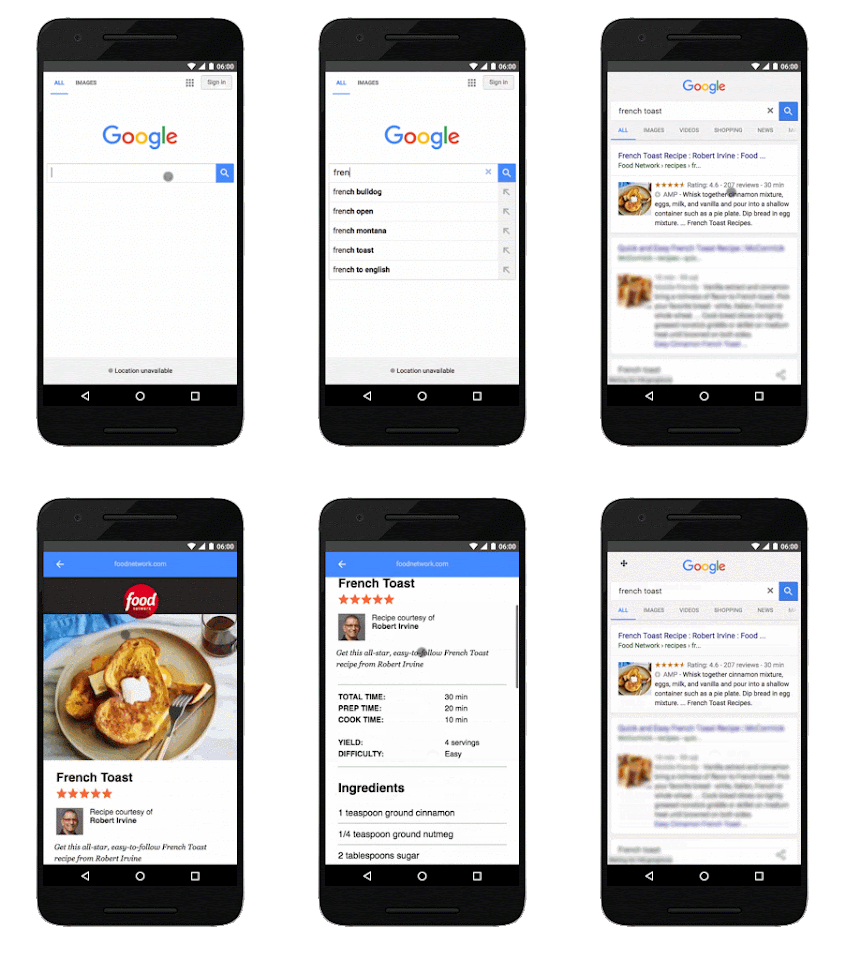
https://3.bp.blogspot.com/-LdyYewdm_FM/V6BVulm3nUI/AAAAAAAABtQ/jH99mcZ_WKklsH-zzJWW-kwCKvpK2j1NgCLcB/s480/ampexample1.gif

Here's a link to the demo [g.co...]

aakk9999

1:14 pm on Aug 3, 2016 (gmt 0)

WebmasterWorld Senior Member 10+ Year Member Top Contributors Of The Month


Hmm.. it used to be "have a desktop and have a mobile site", then "we prefer one single responsive site".
I am wondering whether now we should be building a desktop site and then a separate AMP version of the site for a mobile. Because having an AMP site on the desktop is quite limiting from the design and UX point of view, yet AMP seems so fast on the mobile.

engine

1:24 pm on Aug 3, 2016 (gmt 0)

WebmasterWorld Administrator 10+ Year Member Top Contributors Of The Month


It really is sounding as if that's correct. AMP is becoming the mobile site, as opposed to being mobile friendly.
In addition, we want to give everyone who might be interested in “AMPing up” their content enough time to learn how to implement AMP and to see how their content appears in the demo.

blend27

5:24 pm on Aug 3, 2016 (gmt 0)

WebmasterWorld Senior Member 10+ Year Member Top Contributors Of The Month


In addition, we.....

That is their way.

The <body starts on line 46, the actual content... exactly what they want you to know...

aristotle

7:50 pm on Aug 3, 2016 (gmt 0)

WebmasterWorld Senior Member 10+ Year Member Top Contributors Of The Month


My pages are already extremely fast. I seriously doubt that implementing this AMP code would make them noticely faster. So what would I gain by spending all the time it would take to do it?

bakedjake

7:53 pm on Aug 3, 2016 (gmt 0)

WebmasterWorld Administrator 10+ Year Member Top Contributors Of The Month


So what would I gain by spending all the time it would take to do it?

Eventual preference in mobile search results over non-AMP content would be my guess.

aristotle

8:58 pm on Aug 3, 2016 (gmt 0)

WebmasterWorld Senior Member 10+ Year Member Top Contributors Of The Month


Eventual preference in mobile search results

Shouldn't that be based on the users' experience rather than on whether or not you use some particular coding method?

Paperchaser

9:52 pm on Aug 3, 2016 (gmt 0)

10+ Year Member


@aakk9999 Totally agree with you, after respecting all their demands there always more.... @bakedjake if that's the case there no end to this dictatorship

johnhh

10:49 pm on Aug 3, 2016 (gmt 0)

WebmasterWorld Senior Member 10+ Year Member Top Contributors Of The Month


Step forward to 2017
Google announces no longer supporting AMP as now replaced by RAMP.
Just another fad. don't follow fad's follow trends.

Swanny007

4:54 am on Aug 4, 2016 (gmt 0)

WebmasterWorld Senior Member 10+ Year Member Top Contributors Of The Month


I'm tired of asking "how high ?" when Google says jump. Sigh.

WebEnthusiast

5:07 am on Aug 4, 2016 (gmt 0)

10+ Year Member


They will keep AMP as well they will try to expand it and I am sure they will try to put a ranking signal on it, so that everyone is forced to do it. Why? Because then everything stays to them. All traffic goes over them, they can track things better, sell better data, figure out what ad to show you so you will buy stuff etc.

As it seems really good for people, it is much more better for google and their business model.

... after it they will be internet. Something they want.

JS_Harris

10:51 am on Aug 4, 2016 (gmt 0)

WebmasterWorld Senior Member 10+ Year Member Top Contributors Of The Month


My static pages are better performing without AMP than they are with it. AMP simply adds more code bloat and processing to static pages that don't need it. Considering most cache pages are essentially static html AMP is in fact slowing some pages down. Making AMP required for rankings in SERPs is a mistake, I won't do it unless I see some actual benefit.

Come to think of it static pages that process no user information don't need to be secure either, HTTPS costs more and adds another fail point for no benefit to static content. Maybe Google isn't used to seeing good ol' fashioned plain html anymore?

nomis5

11:37 am on Aug 4, 2016 (gmt 0)

WebmasterWorld Senior Member 10+ Year Member Top Contributors Of The Month


Anyone know if a Wordpress or joomla website can be AMP?

There's a huge number of those sites out there with a massive amount of code bloat.

EditorialGuy

3:46 pm on Aug 4, 2016 (gmt 0)

WebmasterWorld Senior Member 10+ Year Member Top Contributors Of The Month


I am wondering whether now we should be building a desktop site and then a separate AMP version of the site for a mobile.

Could be. There are advantages to having a mobile site that's optimized for mobile without compromising your desktop site, especially if the latter generates significant traffic and revenue. Too many "responsive" sites are neither fish nor fowl in terms of serving up an appetizing user experience.

As to whether AMP will receive a "ranking advantage," one thing to keep in mind is that "ranking advantage" doesn't mean "automatically ranked first." Last March, when Google announced that it was cranking up the "mobile-friendly" signal in mobile search, it still pointed out:
"And remember, the intent of the search query is still a very strong signal — so even if a page with high quality content is not mobile-friendly, it could still rank well if it has great, relevant content."

[webmasters.googleblog.com...]

Paperchaser

4:24 pm on Aug 4, 2016 (gmt 0)

10+ Year Member


Hey guys i just received a message on my GWT about amp today did any of you get this as well? The title is what worries me to be franc...

----
Create AMP pages to be shown in Google Search for http://example.com/
To: Owner of http://example.com/,
Google has detected that your site has many pages that may benefit from being served as AMP pages. Accelerated Mobile Pages (AMP) are HTML pages that are optimized to load fast on mobile devices. Learn more about AMP benefits in the resources below. Valid AMP pages on your site will be eligible to be shown in search results and receive special badging in search results.
----

[edited by: Robert_Charlton at 12:49 am (utc) on Aug 5, 2016]
[edit reason] added "example" to sample domain to disable auto-linking [/edit]

bakedjake

4:34 pm on Aug 4, 2016 (gmt 0)

WebmasterWorld Administrator 10+ Year Member Top Contributors Of The Month


Just another fad. don't follow fad's follow trends.

I don't think so. Google's making a big effort to promote AMP ads. I don't remember where I read it recently, but someone wrote something to the effect of "AMP is Google's attempt to save AdSense on mobile devices". If anyone remembers who said that, let me know so I can credit them!

I think AMP is strategic to Google.

Speaking of, do any members have any experience on the AdSense side using amp-ad? [github.com...]

FranticFish

6:31 am on Aug 5, 2016 (gmt 0)

WebmasterWorld Senior Member 10+ Year Member Top Contributors Of The Month


Google pushed Google+ for all it was worth too.

Robert Charlton

8:04 am on Aug 5, 2016 (gmt 0)

WebmasterWorld Administrator 10+ Year Member Top Contributors Of The Month


I think that AMP is about creating a platform for publishers to deal with the ad blockers. This IMO requires the kind of collective effort that Google is currently trying to put together.

Whether individuals can develop pages that are faster than AMP pages isn't really the question. It's whether those pages are going to be running ads, and, if they are, it's about what kind of white-listing they'll be able to achieve independently.

I don't think this is simply about AdSense or about Google ads (though of course Google wants those to work). It's about the viability of advertising-sustained content throughout the web, and that's likely broader and deeper than many of us assume.

aristotle

12:42 pm on Aug 5, 2016 (gmt 0)

WebmasterWorld Senior Member 10+ Year Member Top Contributors Of The Month


Robert Charlton -- Good post. I think you're probably right about ads being the driving force behind this. Although it's still not clear what the effect on search rankings will be.

But I'm probably not going to ever implement it on my sites because i don't run ads and don't much care about traffic from phone users anyway.

glakes

4:25 pm on Aug 5, 2016 (gmt 0)


I think that AMP is about creating a platform for publishers to deal with the ad blockers.

If this is the case, then Google should present the facts instead of disingenuously billing AMP's purpose as to speed up slow loading pages.

This IMO requires the kind of collective effort that Google is currently trying to put together.

Once again, people joining this collective effort (webmasters) should be told their help is needed to ensure an ad supported web will exist instead of being recruited for false reasons. For millions of webmasters to spend tens or hundreds of millions of hours implementing something Google says is needed to speed up the mobile web when in fact it is to protect their dominance in advertising (50%+ globally) is a clear abuse of their dominance in the advertising market. Of course the cost burden will weigh heavily on the collective webmaster community that will spend the tens or hundreds of millions of hours implementing Google's trojan horse with no regulator ever batting an eye at the total cost of lost productivity to businesses unknowingly helping to protect Google's dominance.

aristotle

4:40 pm on Aug 5, 2016 (gmt 0)

WebmasterWorld Senior Member 10+ Year Member Top Contributors Of The Month


glakes -- Google needs page speed as a part of their argument, because it gives them an excuse to use the threat of lower search rankings as an incentive to get webmasters to comply.

EditorialGuy

7:18 pm on Aug 5, 2016 (gmt 0)

WebmasterWorld Senior Member 10+ Year Member Top Contributors Of The Month


If this is the case, then Google should present the facts instead of disingenuously billing AMP's purpose as to speed up slow loading pages.

Google pays a lot of attention to usability, and there's no denying that too many sites (including some of the biggest) can be agonizingly slow to load and shamelessly greedy in the bandwidth they consume. If AMP can provide a mechanism for making such sites more mobile-friendly, users will benefit, and so will publishers who learn to practice self-discipline via AMP (regardless of which comes first--the chicken or the egg).

mcneely

9:08 pm on Aug 5, 2016 (gmt 0)

WebmasterWorld Senior Member 10+ Year Member Top Contributors Of The Month


I think you're probably right about ads being the driving force behind this


It's "always" going to be about the money at the end of the day. Google doesn't make a move without first making sure they're going to make a buck.

As far as adblockers and ads? .. Well lets just say that pages that serve ads are "always" going to load slower than pages without ads - No amount of gimmickery (if that's even a word) is ever going to change that fact.

EditorialGuy

10:28 pm on Aug 5, 2016 (gmt 0)

WebmasterWorld Senior Member 10+ Year Member Top Contributors Of The Month


t's "always" going to be about the money at the end of the day. Google doesn't make a move without first making sure they're going to make a buck.

Then again, some things--like Google News--are loss leaders. But whether a business hopes to earn a profit (oh, the horrors!) is beside the point. AMP is here, it's expanding, some publishers will find it useful, and some publishers won't.

Nutterum

2:00 pm on Aug 9, 2016 (gmt 0)

10+ Year Member Top Contributors Of The Month


I doubt any type of publisher will find it not useful. Honestly I am sort of tired of the front-end developers moaning about what they do not like about AMP. Their job is to build it so the website master can do his job and drive impressions, clicks and sales via content published on the organic SERPS. Simple as that. Does Google try to cut the line of viewers using Facebook Instant Articles and Apple News? Sure! Then again this is something they are supposed to be doing anyways, because they are business looking for profit, just like us.

Also I already installed AdBlockers that catch AMP ads and I am telling you this so that I can stop the Google-is-doing-it-to-battle-adBlockers hilarious conspiracy going on in the minds of many.

tangor

8:51 pm on Aug 9, 2016 (gmt 0)

WebmasterWorld Senior Member 10+ Year Member Top Contributors Of The Month


I don't have a mobile so can't test it that way, but when running in high contrast and acceesiblity mode, as well as noscript and js off, there isn't a lick of difference "before" or "after". A number of my friends are changing their phones the same way simply because they are getting that much older and vision is degraded .... I suspect the same results will apply.

That said, there's nothing wrong with attempting to set a new standard for coding web content. AMP does radically reduce some reliance on js and other technologies. Whether a new standard can actually be developed is something else entirely.

Anyone know what the uptake on AMP has been since it rolled out?

Nutterum

7:18 am on Aug 11, 2016 (gmt 0)

10+ Year Member Top Contributors Of The Month


@tangor - Yes. All major publishers use it. Most major companies that run high content volumes use it. In Europe and Asia it has not picked up because until recently it was only available in US/UK/AUS . I see some WP developers incorporating the technology in their new themes they sell on Themeforset and other outlets. Now that AMP is going global, I suspect that even more publishers and online outlets of newspapers will bite the bullet and adopt AMP.

In my mind the technology is here to stay. I even go as far as to speculate that in time there will be a wave of "AMP only" websites rolling, pushed by the speculation machine that is the SEO and Digital Marketing industry.

jrs79

2:29 pm on Aug 11, 2016 (gmt 0)

10+ Year Member Top Contributors Of The Month


Is AMP still exclusively for news/information sites? I haven't seen any commerce or b2b sites utilizing it yet.

Broadway

7:59 pm on Aug 14, 2016 (gmt 0)

WebmasterWorld Senior Member 10+ Year Member Top Contributors Of The Month


<moved from another location>

I'm an Adsense publisher so the issue of browser ad blocking is something I pay attention to.

I recently read where Facebook was able to disrupt (at least temporarily) ad-blocking software.

I am also aware of Google's AMP (accelerate mobile pages) project.
I was under the impression that AMP pages weren't called from your own server but cached and served from a Google CDN.

Since Google looses some Adsense income when ad blockers are used, might they be able to come up with a universal ad-blocker work around for AMP pages since they are served from their own servers?

Collectively, humans seem to do what is in their immediate best interest.
It's easy enough to see how the music and movie industries have been affected by pirating.
Since ad blocking saves bandwidth and gets rid of anoying ads, I can clearly see why people use them.
At the same time, as a publisher I can only hope that some revenue stream will still exist in the future.

I was under the impression that the AMP project placed some limitations on the types (characteristics) of ads served. For the publishing industry it would be fortuitous if AMP could be used as a way to usher in (force) a new era of advertising found on the web. One where it could still exist but at minimum impact/detriment to web surfers.

[edited by: aakk9999 at 10:31 am (utc) on Aug 15, 2016]

james007

11:47 am on Aug 15, 2016 (gmt 0)

10+ Year Member Top Contributors Of The Month


I've implemented two AMP projects - first, I changed my (very simple) personal website to be AMP-enabled for everyone. It's not true that AMP is only good for mobile: because it uses a very stripped-down version of HTML, it means speed increases for every single website. You can have an AMP site as your only site, if you're happy with the lack of functionality. (In my case, my personal website is on static webspace on Amazon S3, so I don't mind.)

Second - I enabled AMP pages for some news articles on my main website. These have had very low amounts of traffic so far. I'm not sure it's worth it, but it's clearly important to keep trying these things. These do have Google AdSense ads in them. AMP loads these as IFRAMES within the page - the idea there is that the page snaps into place, and the ads then load afterwards.

Certainly, by loading The Guardian's AMP pages with an ad-blocker in place, the ads disappear. Ad blockers are much less prevalent on mobile, however.

I think AMP is a good thing; it appears to be cutting out a lot of the cruft and nonsense of the web and returning it to something rather more pure and clean.

Finally, AMP wasn't turned on properly in Australia until recently - no Google searches ever gave an AMP result. I notice tonight that a search ("obama") is now returning AMP results, which appears to be relatively new. A search for "Turnbull" - our Prime Minister - returns three news stories, none of which are Australian news organisations, however.
This 33 message thread spans 2 pages: 33