Forum Moderators: Robert Charlton & goodroi

Message Too Old, No Replies

Google Previews Expanded AMP Support in Entire SERPs


engine

11:36 am on Aug 3, 2016 (gmt 0)

WebmasterWorld Administrator 10+ Year Member Top Contributors Of The Month


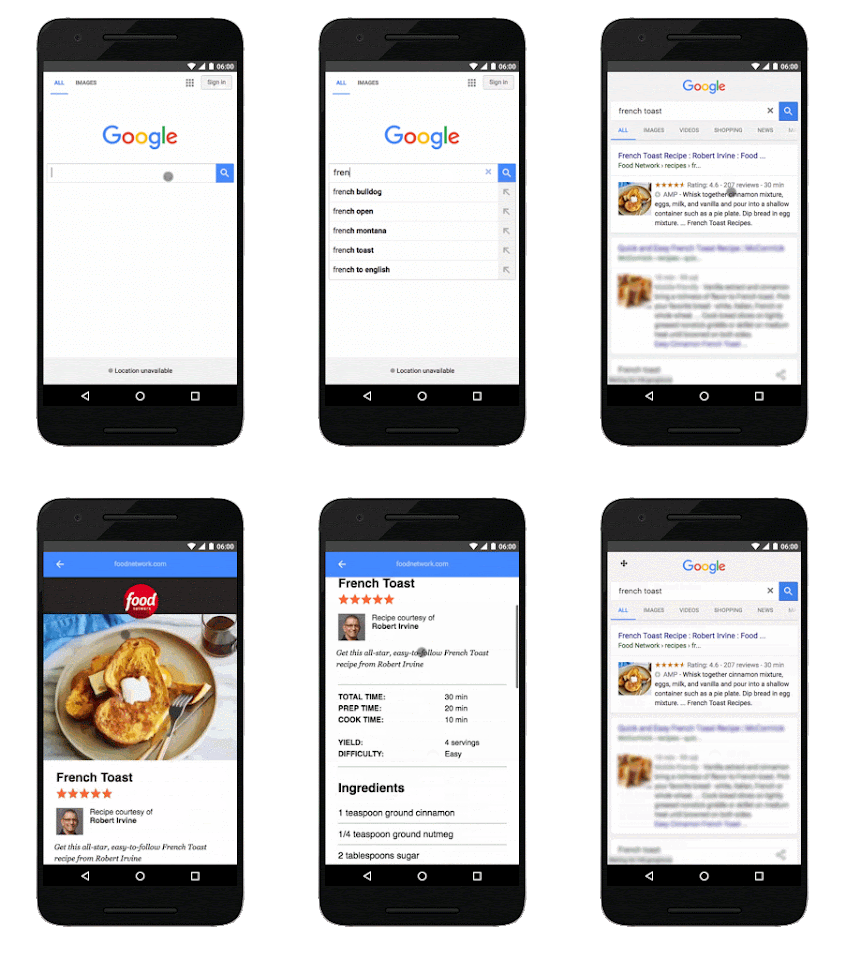
Google is showing a preview of its expanded AMP results. It confirms this is not a ranking change, but purely a faster and easier way to get to the AMP page in the AMP viewer. This new AMP support will roll out later in the year.
Try it out for yourself on your mobile device by navigating to g.co/ampdemo. Once you’re in the demo, search for something like “french toast recipe” or music lyrics by your favorite artist to experience how AMP can provide a speedier reading experience on the mobile web. The “Who” page on AMPProject.org has a flavor of some of the sites already creating AMP content.Google Previews Expanded AMP Support in Entire SERPs [webmasters.googleblog.com]
https://3.bp.blogspot.com/-LdyYewdm_FM/V6BVulm3nUI/AAAAAAAABtQ/jH99mcZ_WKklsH-zzJWW-kwCKvpK2j1NgCLcB/s480/ampexample1.gif

Here's a link to the demo [g.co...]

Nutterum

6:50 am on Aug 16, 2016 (gmt 0)

10+ Year Member Top Contributors Of The Month


AMP was quickly adopted in the US due to the presidential race. Trump used it to great effect, capitalizing on the void in the AMP niche and his team spammed a quadrillion AMP only pro-trump websites with spun content. Until other could catch up Trump had a solid two month rain in all related Google search queries on mobile. I know this because I had to make an in in depth research on AMP for a client who wanted to migrate their entire blog section (3k+ posts!) to AMP and was wandering whether it is worthwhile.

But let me be clear - AMP is still niche thing, served for high traffic keywords mostly. If you prepare you can get ahead of the pack when your topical niche opens up for AMP searches. Ignoring it however will be a net loss in the mid-long term for sure though.

Robert Charlton

9:02 am on Aug 17, 2016 (gmt 0)

WebmasterWorld Administrator 10+ Year Member Top Contributors Of The Month


...I already installed AdBlockers that catch AMP ads and I am telling you this so that I can stop the Google-is-doing-it-to-battle-adBlockers hilarious conspiracy going on in the minds of many.
Instant disabling of ad blockers, IMO, is not a good model for what's going on. I don't think they're striving for a technical solution to fake out the ad blockers... (such as we're now seeing in process with Facebook and those blockers).

Thinking out loud here, I'm assuming that the publishers and Google are going for an eventual political or economic settlement with the ad blocking organizations, as well as agreement among themselves, based on significantly improved performance of pages. It could also involve hearts and minds of users. There's a lot that's open source and trial and error aiming for consensus that appears to be built into the AMP project. Possibly, if the ad-blockers don't come to terms, the opposing sides might have to take it to the courts, if there are grounds for doing so. IANAL.

It feels to me like there's a degree of extortion in this game, coming from the ad-blockers, and this is probably going to unfold more like a game of poker than like a technical battle. That's my admittedly inexperienced interpretation of what I'm seeing going on. But I doubt that it's going to be neat and technical.

So installing AdBlockers to catch AMP ads now confirms, as you're discovering, that such technical challenges would be an unfruitful approach, unlikely to affect the end-game that will need to be played. There's too much money involved for this to get settled that way. But, without cleaning up their act considerably, the ad networks and publishers are in a hopeless negotiating situation, because they won't have the users on their side.

Facebook, OTOH, is a closed system where a technical approach might work... though I'm suspecting not.

james007

12:05 pm on Aug 17, 2016 (gmt 0)

10+ Year Member Top Contributors Of The Month


AMP is intended for mobiles (indeed, it doesn't even kick in on my Nexus 7).

Google is conditioning users on Android to use the Google app to search - that's the search bar on the homescreen. When you search in this app, you're not using your default web-browser: you're using the Google app's own webview component. This is much harder for an ad-blocker to work in. An ad-blocker would need to be upstream (acting like a VPN or proxy across the entire system), and this would be detectable relatively simply by the Google app if it so desired. Indeed, Google have the capability of disabling and removing APKs from a user's Android phone if they wish.

I've now noticed AMP being used extensively both in Google Search but also in the Google News app, which appears to be now preferring AMP content to non-AMP. In Australia, few content providers are enabled for AMP, so I'm getting a lot of the Sydney Morning Herald, and little else from other providers: nothing from my local newspaper nor from the ABC, the public service broadcaster here. Once more, since these AMP pages are not in a web browser, it's more complex for ads to be blocked.

Additionally, it could be the case (I don't know) that Google's using an encrypted connection, including an encrypting proxy or cache, for all AMP pages in this way. This means that even if an ad-blocker is sitting further up the chain (like in a VPN configuration) it will still not work. Certainly, that's one reason why I always enable Google's Data Saver on Android and on my Chrome browsers - because it makes all non-encrypted web pages go via an encrypted proxy server at Google, and therefore Wifi hotspots or ISPs can't inject other content or advertising into my web browsing. I've seen both tamper with my web-browsing experience in the past, incidentally.

The bright lights on the horizon are, for me at least, that AMP is much more locked-down in terms of errant JavaScript; and pages load fast and quickly even if the ads take a long time to eventually show in their placeholders. AdSense is very slow for me to load up in my otherwise speedy AMP pages. I suspect that the slimmed-down AMP pages will be seen by consumers as a good thing, and they'll be happier to click on pages with the AMP symbol than pages without. And, perhaps, that's the point - and why Google wants speedier web pages and AMP to be implemented.

Facebook's only a closed system on mobile, by the way, not desktop.
This 33 message thread spans 2 pages: 33